Detailed guide
Part 1: Preparing Components and Safety Notes
Introduces the component list, each module's role, and safety notes for working with water and electronic circuits.
Updated 31/08/2026
Part 1: Preparing Components and Safety Notes
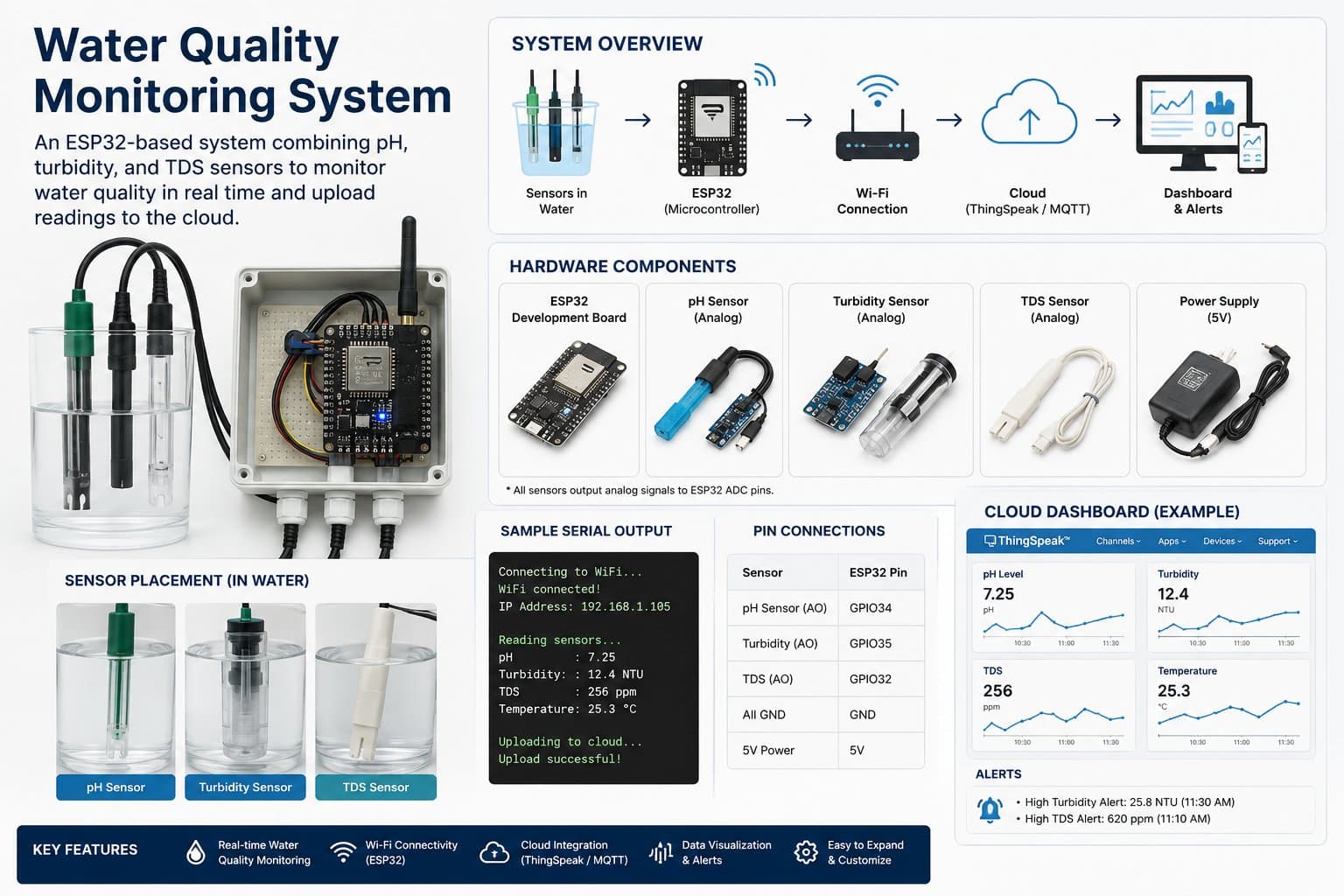
Before starting, gather all the components and understand each part's role in the system. This project uses an ESP32 as the central controller, water sensors as inputs, and LEDs/a buzzer as alert outputs.
1.1. Required Components
| Component | Qty | Role |
|---|---|---|
| ESP32 DevKit V1 | 1 | Main control board, reads sensors and sends data. |
| Waterproof DS18B20 | 1 | Measures water temperature. |
| TDS Sensor (analog) | 1 | Measures total dissolved solids in water. |
| pH Sensor (analog) | 1 | Measures the water's acidity/alkalinity. |
| Turbidity Sensor | 1 | Measures relative turbidity. |
| 4.7kΩ Resistor | 1 | Pulls up the DS18B20's DATA pin. |
| Green LED, red LED, buzzer | 1 set | Water status alerts. |
| Dupont wires, breadboard, 5V power | 1 set | Wiring and test power supply. |
1.2. Optional Extension Components
- A 0.96-inch I2C OLED for local data display.
- An IP65 waterproof enclosure for packaging the prototype.
- An external ADS1115 ADC for more stable analog readings.
- A stable 5V/3.3V power module for long-term deployment.
1.3. Safety Notes
- Never let water touch the ESP32, breadboard, or power circuit.
- Only submerge the sensor's probe end in water.
- Never feed a 5V analog signal directly into an ESP32 ADC pin.
- If a sensor's output exceeds 3.3V, use a voltage divider or a suitable ADC.
- Always share a common GND between the ESP32 and every sensor module.
Remember: this is a reference monitoring system, not a certified drinking-water testing device.