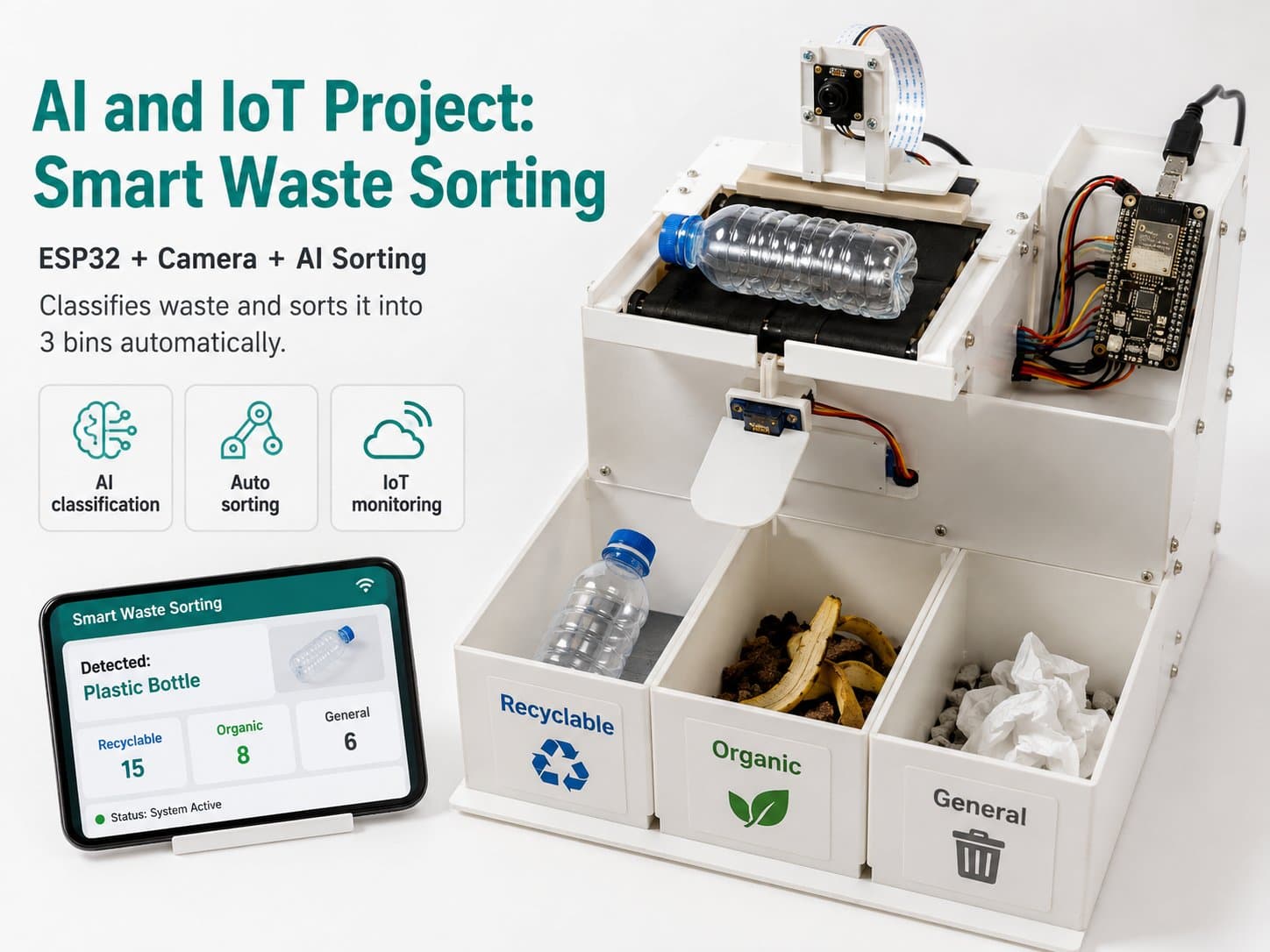
Part 1: Project Introduction and Hardware Preparation
1. Project overview; 2. Goals and scope; 3. Required hardware list; 4. Shopping and component selection guide; 5. Introducing the Raspberry Pi and the sensors; 6. Notes on assembling the hardware.
Part 1: Project Introduction and Hardware Preparation
1. Project Overview
The "AI and IoT: Smart Waste Sorting" project aims to build a device that automatically recognizes and sorts waste using AI and IoT technology. The device uses a Raspberry Pi and sensors to raise environmental awareness by sorting waste accurately and efficiently.
2. Goals and Scope
The project's goal is to build a system that can sort waste into 4 main categories: Plastic, Metal, Paper/cardboard, and Other/uncertain. The system needs high reliability and the ability to handle unidentified waste.
3. Required Hardware List
Processing computer: Raspberry Pi 5
Camera: a Raspberry Pi Camera Module or a USB camera
Lighting: a fixed white LED inside the recognition chamber
Weight sensor: a load cell + HX711
Metal sensor: an inductive proximity sensor (detects only ferrous metal, not aluminum)
Distance sensor: a VL53L0X (maximum range ~2m, best under 1.2m) or an ultrasonic sensor (more robust for object detection)
Sorting mechanism: a servo or stepper motor
IoT connectivity: WiFi + MQTT
Dashboard: a web dashboard or the IoTLabs MQTT dashboard
4. Shopping and Component Selection Guide
When buying components, choose genuine products to ensure quality and compatibility. Components like the Raspberry Pi 5, the camera, and the sensors can be found on major e-commerce sites or specialized electronics stores. Check the specs and reviews before deciding to buy. Note that the Raspberry Pi AI Kit requires Raspberry Pi OS Bookworm (or newer) and the latest firmware/drivers.
5. Introducing the Raspberry Pi and the Sensors
The Raspberry Pi 5 is a compact, powerful computer well suited for AI applications thanks to its strong processing power and support for many connectivity protocols. Sensors like the load cell, the metal sensor, and the distance sensor help gather the data needed to sort waste accurately. Note that INT8 quantization may need calibration with a representative dataset, and not every model can be quantized without losing accuracy.
6. Notes on Assembling the Hardware
Warning: when assembling the hardware, make sure the power supply is stable and the connections between components are correct, to avoid damaging the device.
Make sure the camera is mounted in the right position for an optimal viewing angle. The sensors also need to be mounted securely to work effectively. Test each component individually before assembling the whole system.